Gallery · M78
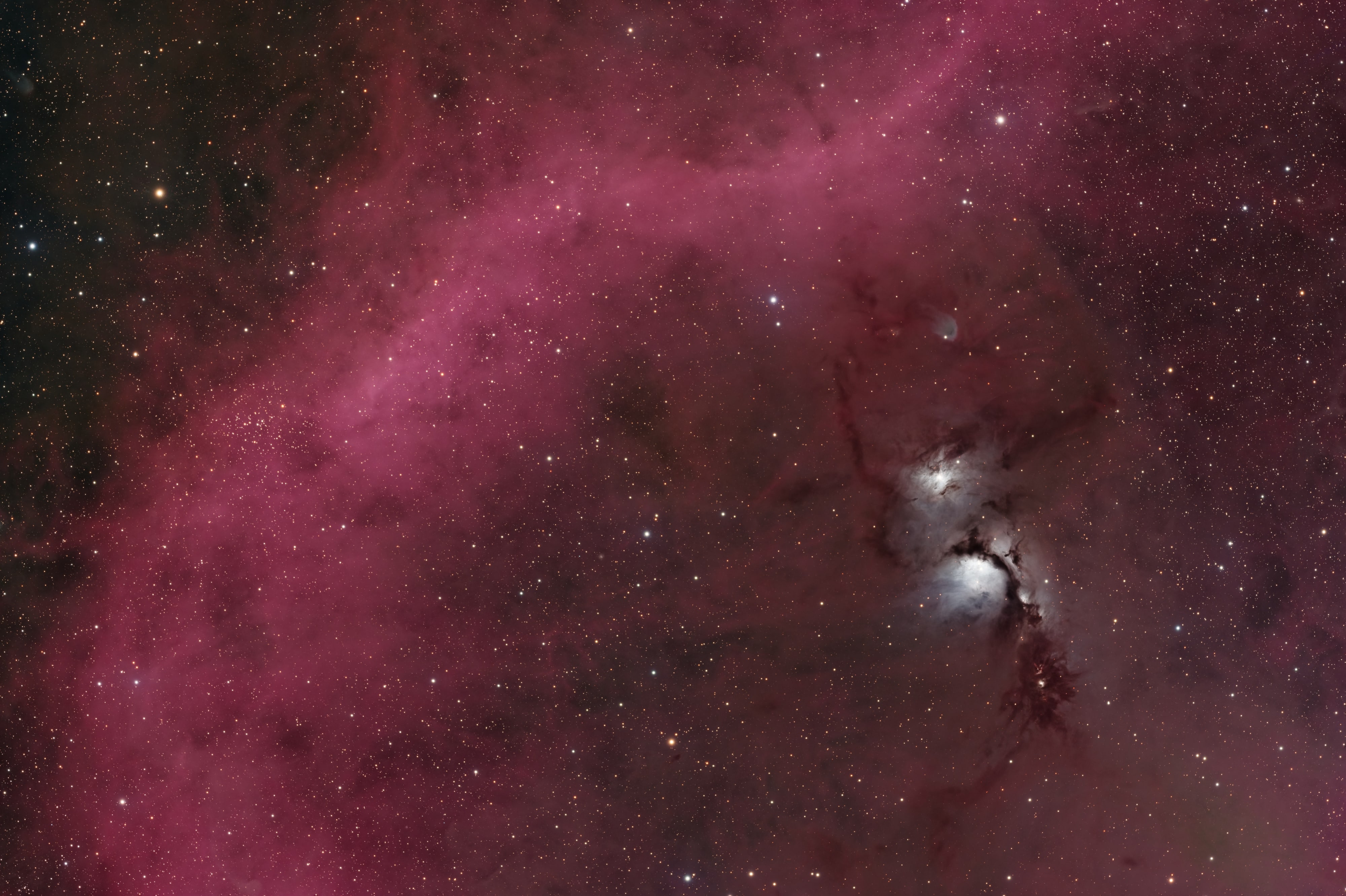
Reflection nebula and Barnard's Loop
Single-image broadband with hydrogen, HaLRGB
- Integration
- 43.0 h
- Constellation
- Orion
- Optics
- SharpStar 94EDPH refractor
- Camera
- QHY268M
- Field of view
- 3.3° × 2.2°
- Dates
- 3 November 2025 to 12 March 2026
Description
This 3.3° by 2.2° field, in Orion, northeast of the Belt, brings together two very different objects, about 1,350 light-years away.
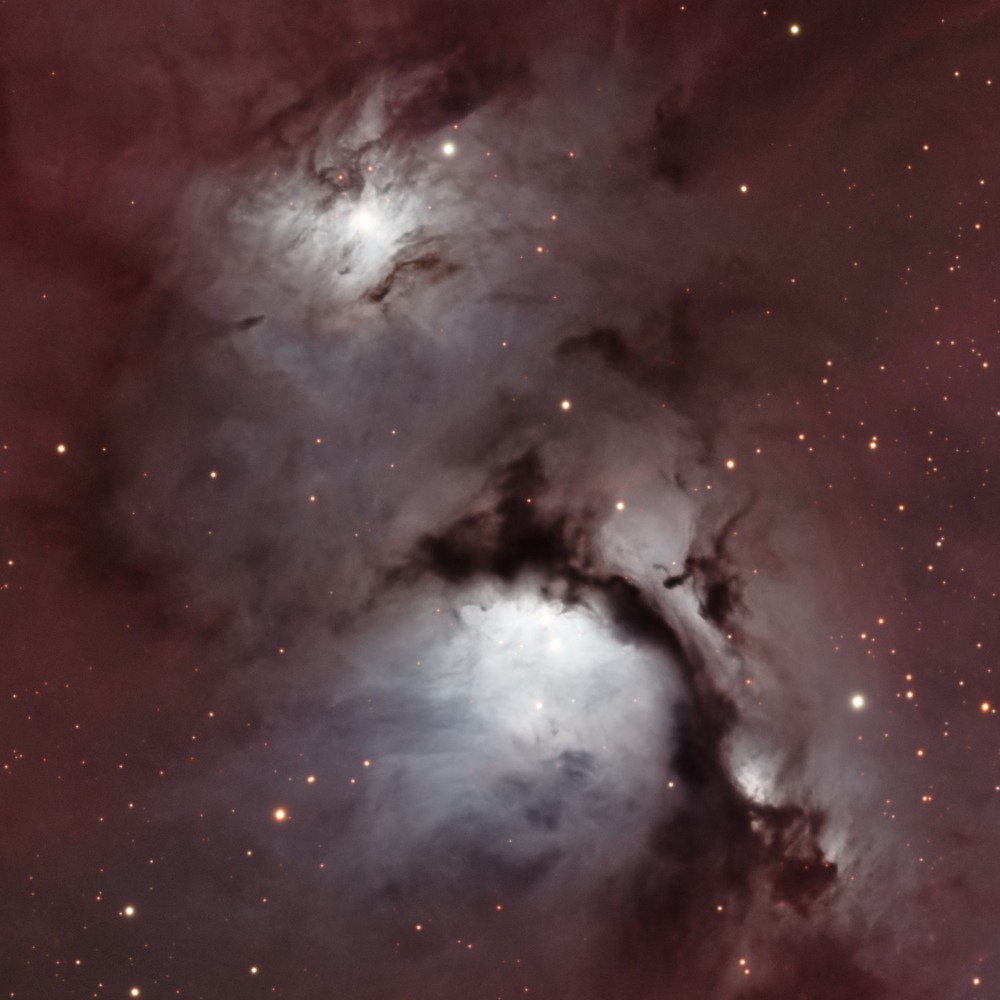
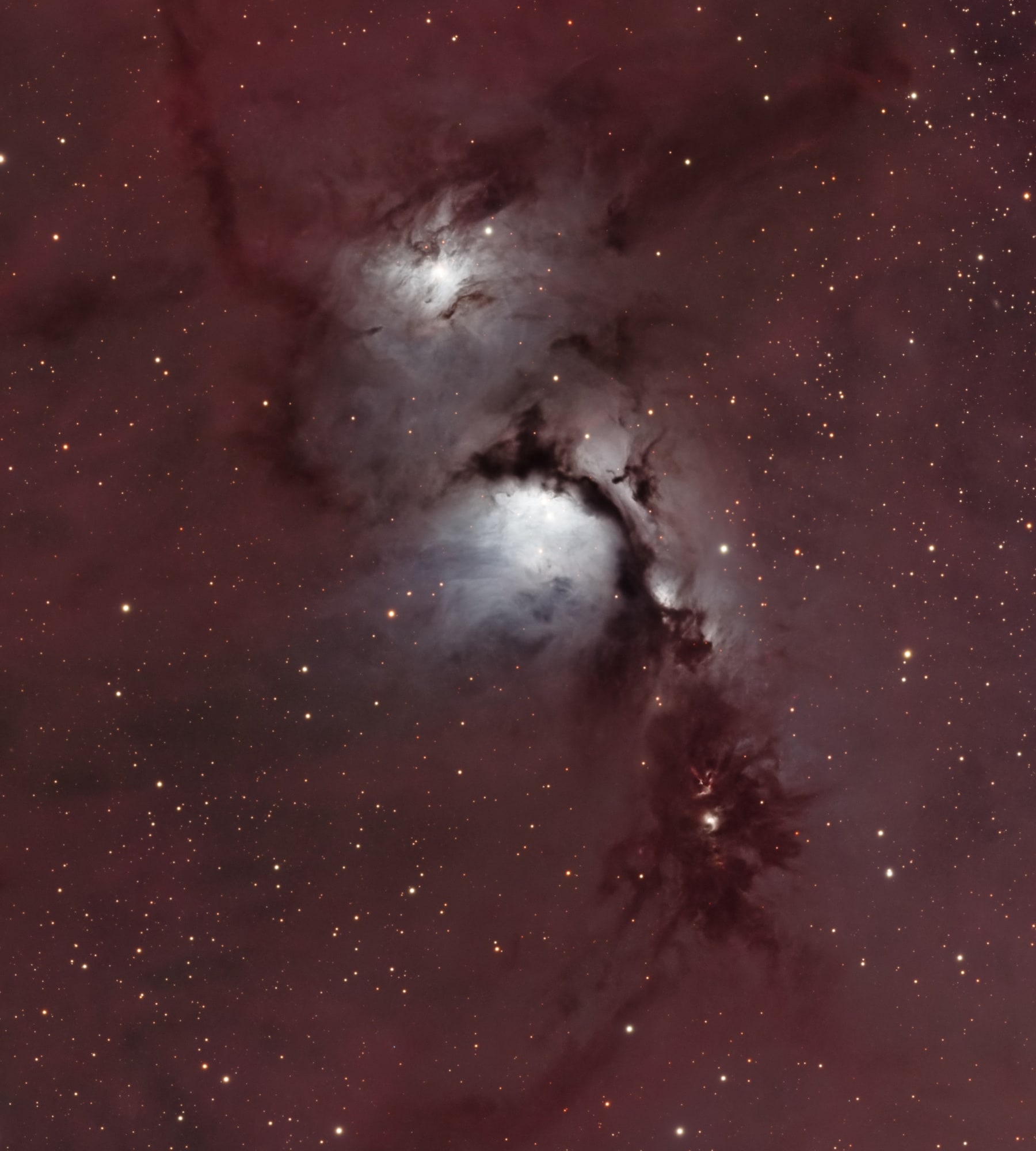
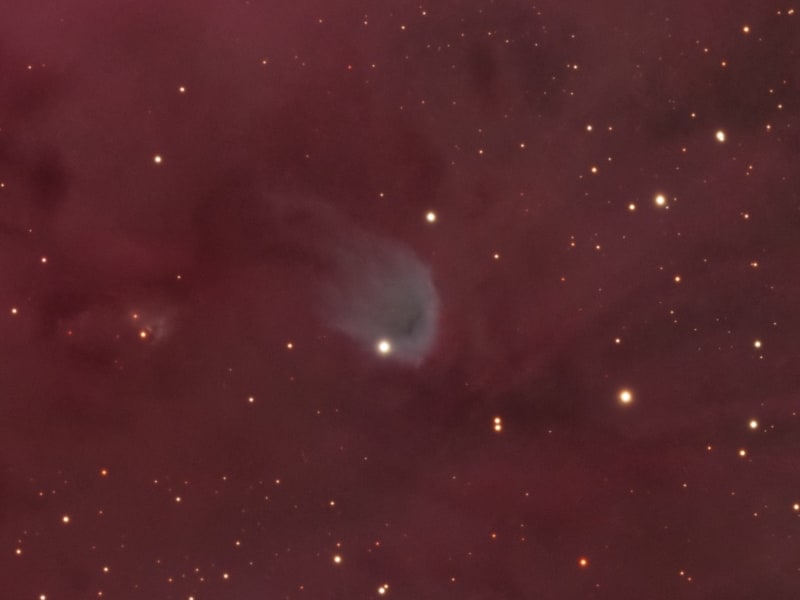
M78, on the right, is the brightest reflection nebula in the sky: a cloud of dust scattering the bluish light of young embedded stars. It is accompanied by NGC 2071, just above, and crossed by thick bands of opaque dust that continue downwards. At upper right, the small pale fan is McNeil's Nebula, lit by a forming star whose brightness varies.
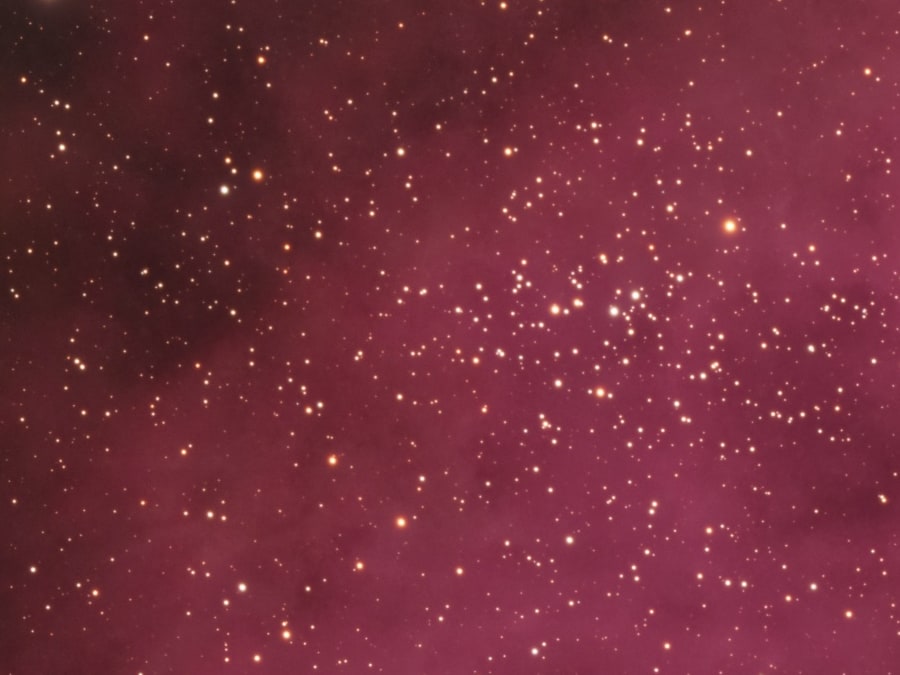
The large red arc crossing the image diagonally is a section of Barnard's Loop, an immense shell of ionized hydrogen surrounding a large part of Orion. Its glow fills almost the whole field; only the upper left corner shows a darker sky.
The colours are close to the real ones: they were calibrated on the stars in the field. The red of the hydrogen is quite real, but far too faint to be seen by eye.
This image was acquired in collaboration with Renaud Venne-Landry.
Finding the field
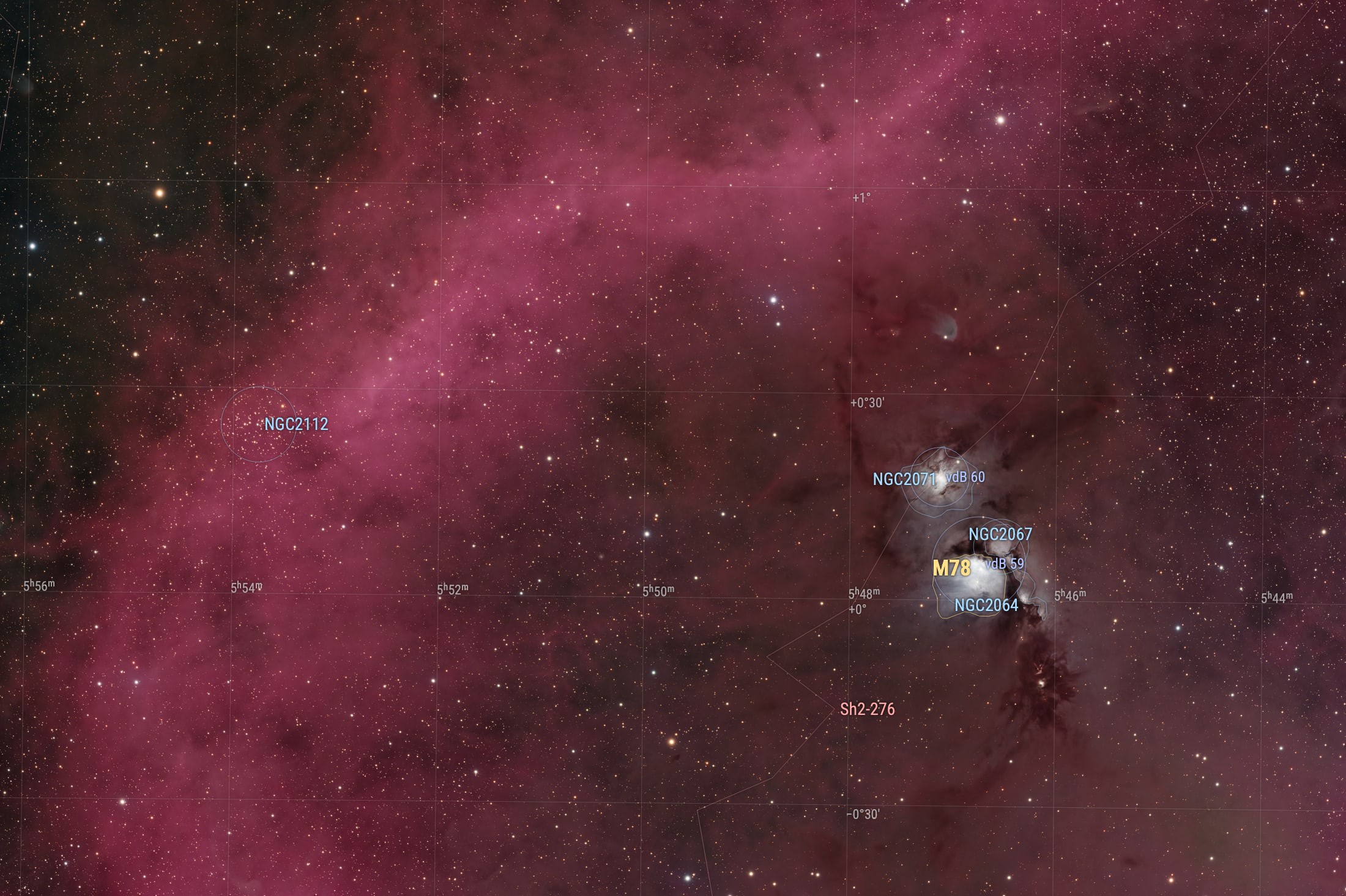
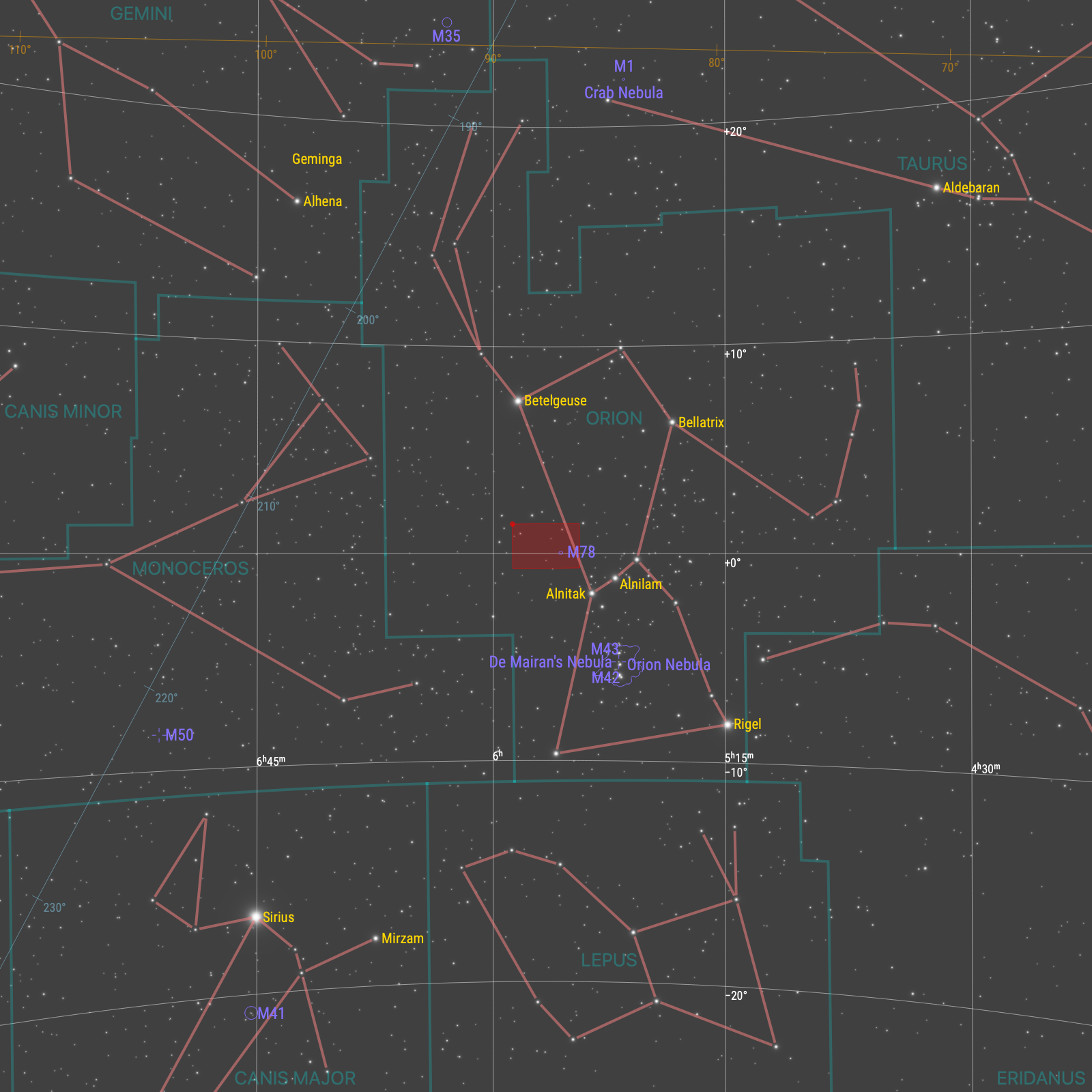
Annotation and chart generated in PixInsight (AnnotateImage, FindingChart) from the image's astrometric solution.
Acquisition
- Location
- Starfront remote site, Texas (31°32'51" N, 99°22'55" W)
- Period
- 3 November 2025 to 12 March 2026
- Camera
- QHY268M (monochrome), gain 56, offset 25, High Gain 2CMS mode, cooled to 0 °C then to −15 °C, 1×1 binning
- Optics
- SharpStar 94EDPH refractor (94 mm aperture) with its dedicated reducer, 409 mm focal length (f/4.4)
- Image scale
- 1.90"/pixel (3.76 µm pixels)
- Filters
- L, R, G, B and Ha
- Software
- Voyager (RoboTarget)
Frames kept:
| Filter | Frames | Sub-exposure | Total | Period |
|---|---|---|---|---|
| L | 144 | 180 s | 7.2 h | 26 November 2025 to 6 March 2026 |
| R | 120 | 180 s | 6.0 h | 12 December 2025 to 11 March 2026 |
| G | 120 | 180 s | 6.0 h | 20 December 2025 to 12 March 2026 |
| B | 120 | 180 s | 6.0 h | 22 December 2025 to 12 March 2026 |
| Ha | 107 | 600 s | 17.8 h | 3 to 9 November 2025 |
- Integration time
- 25.2 h in LRGB + 17.8 h in Ha = 43.0 h (611 frames). One of the 145 L frames could not be aligned and was discarded.
Final image
- Dimensions
- 6228 × 4146 pixels (25.8 megapixels), after cropping the edges
- Field
- about 3.3° × 2.2°
- Field centre
- RA 5h 50m, Dec +0° 22' (telescope pointing)
Processing
Done entirely in PixInsight 1.9.6, starting from the raw frames.
Preprocessing (per filter)
- Calibration: 180 s master darks at 0 °C and at −15 °C depending on the temperature of each frame, 600 s master dark at 0 °C for the Ha; L, R, G, B master flats at −15 °C; Ha master flat at 0 °C.
- Frame alignment, local normalization, stacking.
- Astrometric solution of each stack.
Preparation
- RGB combination and colour calibration on the stars in the field (SpectrophotometricColorCalibration, Gaia catalogue).
- Common cropping of the edges.
Linear processing
- Light gradient correction (AutomaticBackgroundExtractor, degree-1 polynomial).
- BlurXTerminator (deconvolution), NoiseXTerminator (noise reduction), StarXTerminator (separation of stars and nebulae).
Non-linear processing
- Background neutralization, then linked stretch of the three colours, target background level 0.20.
- Very light injection of the Ha into the red (10%), none into the luminance.
- Combination of the luminance with the colour (LRGB), reduced saturation.
- Compression of the bright areas of M78: HDRMultiscaleTransform (6 layers, applied at 80%), with a lightness mask.
- Green toned down (SCNR 0.7), contrast curves.
- DarkStructureEnhance, two passes.
- Reintegration of the stars, stretched less than the nebulae.
Notes
- Fourth version of the rendering. In the first ones, the red flooded the whole field. Reducing the Ha injection changed almost nothing: this red is already present in the R filter. It was lowering the saturation that brought it back to a more natural level.
- Since the sky background is covered with nebulosity, its neutralization is approximate.
- The L, R and B frames taken at 0 °C were calibrated with flats at −15 °C.
Image: Martin Magnan.