Gallery · IC 4604
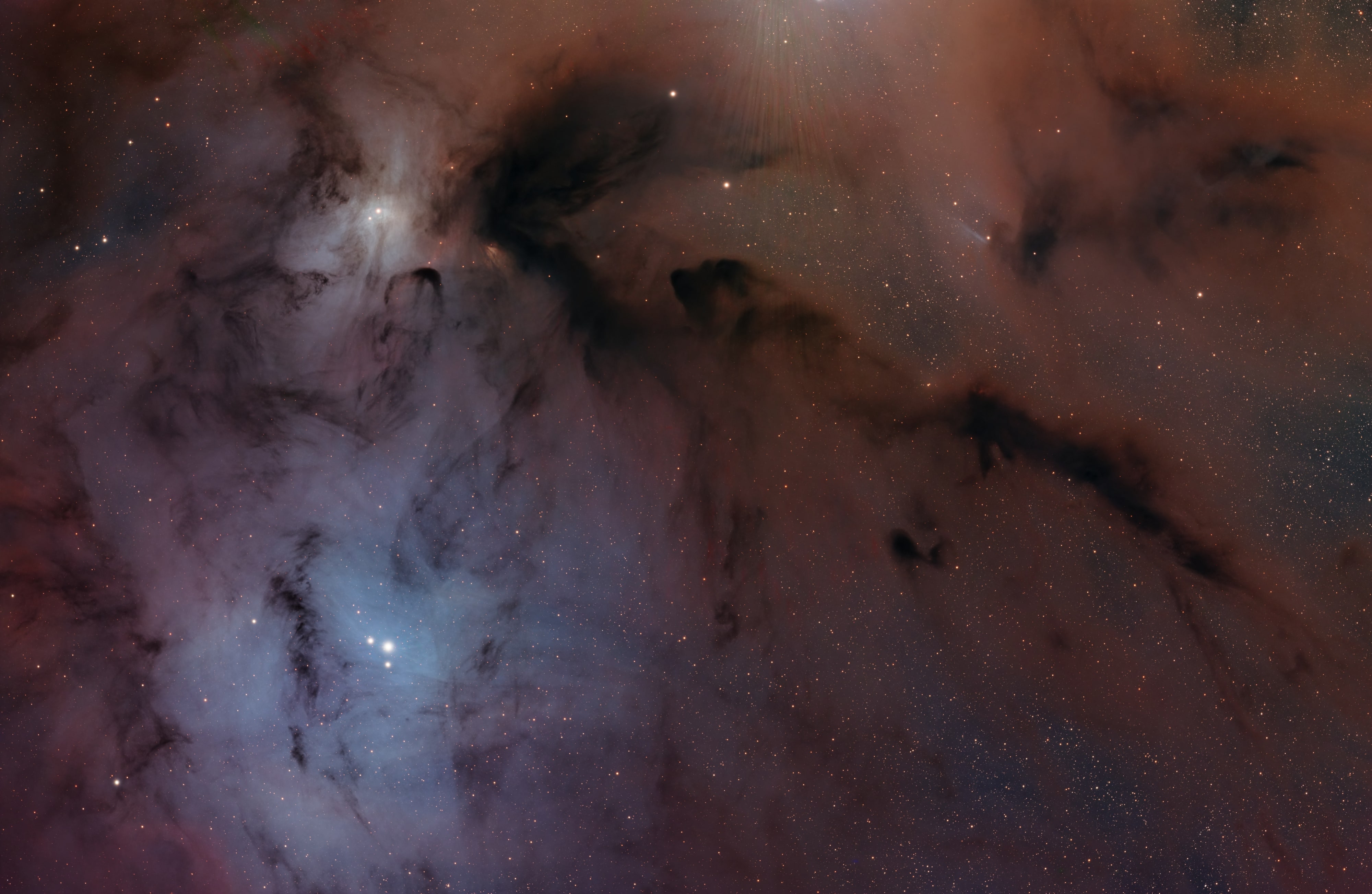
The Rho Ophiuchi cloud
Single-image broadband, LRGB
- Integration
- 19.6 h
- Constellation
- Ophiuchus
- Optics
- SharpStar 94EDPH refractor
- Camera
- QHY268M
- Field of view
- 3.2° × 2.1°
- Dates
- 26 March to 8 July 2026
Description
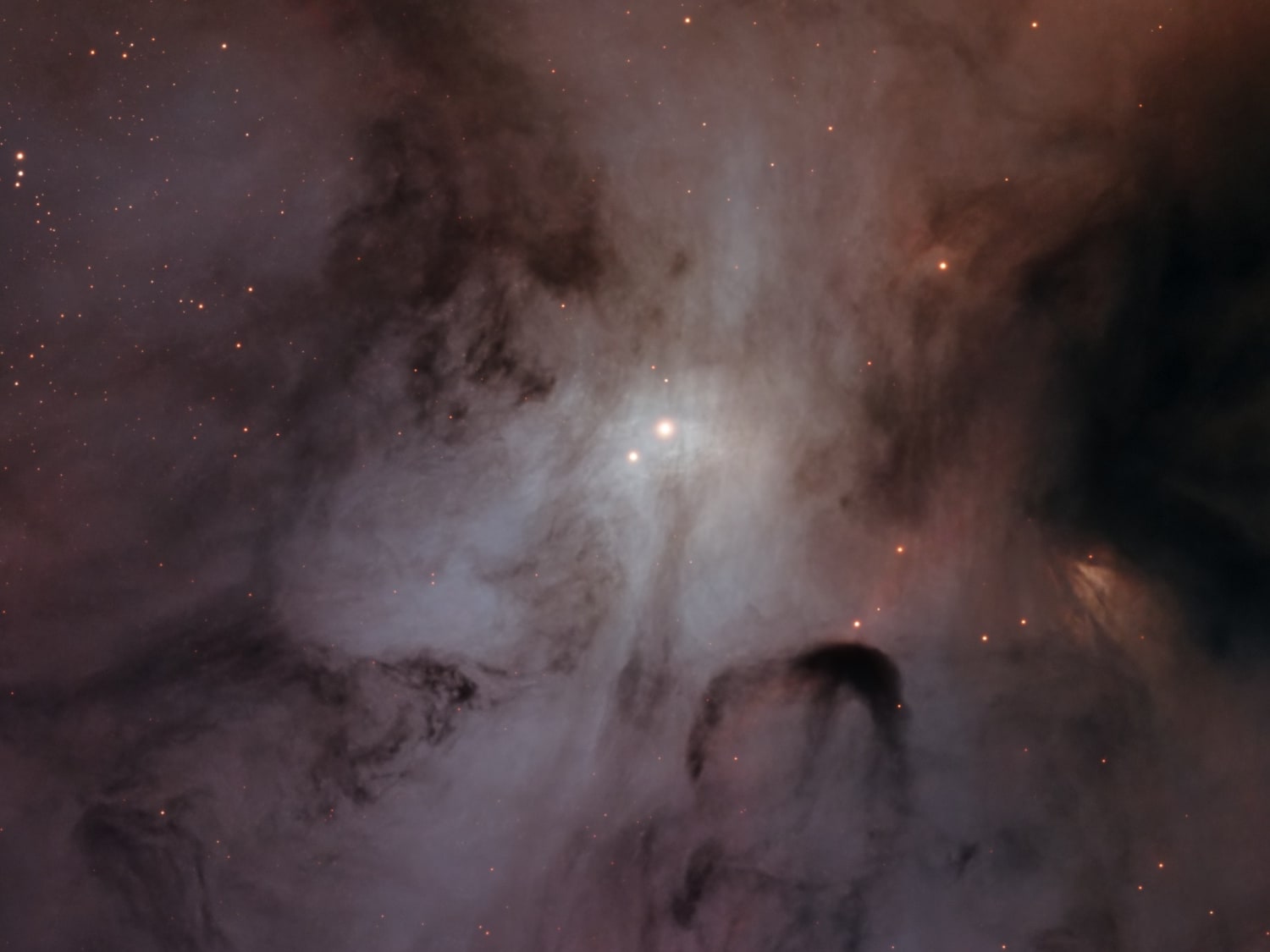
This 3.2° by 2.1° field shows part of the Rho Ophiuchi complex, one of the closest star-forming regions to us, at about 450 light-years, and one of the most colourful in the sky.
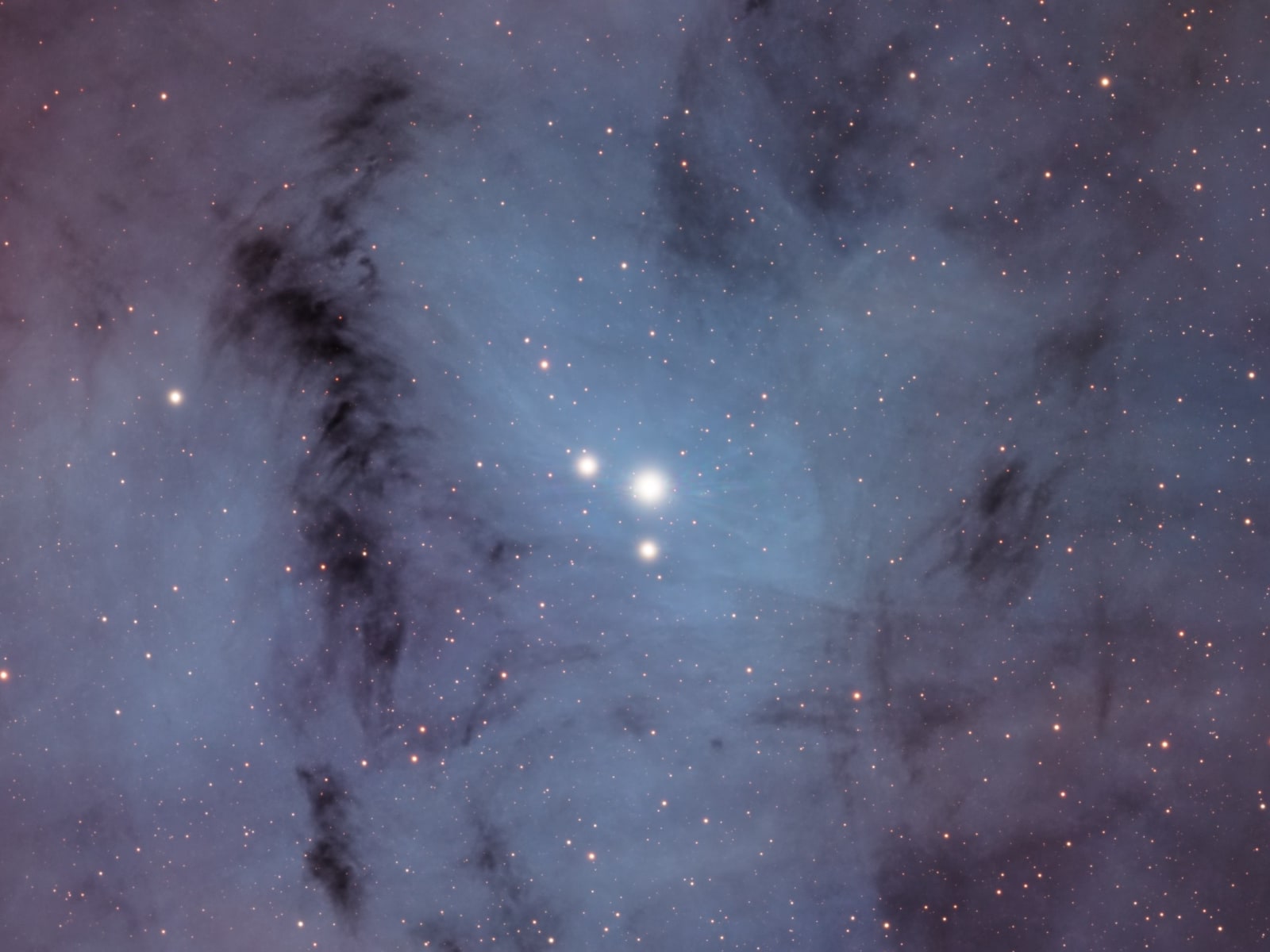
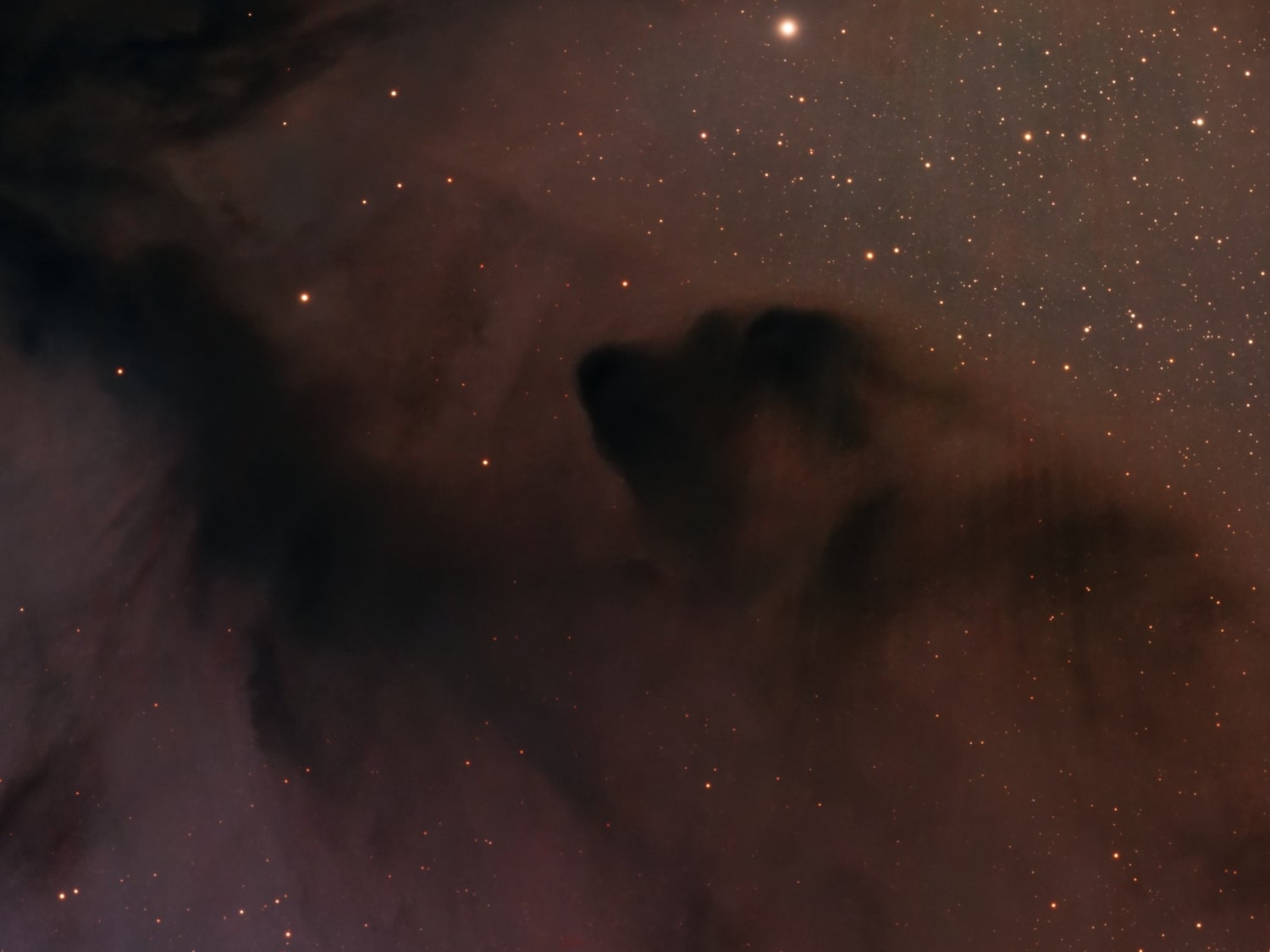
The large blue nebula is IC 4604: dust reflecting the light of the Rho Ophiuchi star system, visible at its centre. It is surrounded by cooler dust clouds in brown-orange hues, and crossed by long dark nebulae, so dense that they completely hide the stars behind them.
The colours are close to the real ones: they were calibrated on the stars in the field.
This image was acquired in collaboration with Renaud Venne-Landry.
Finding the field
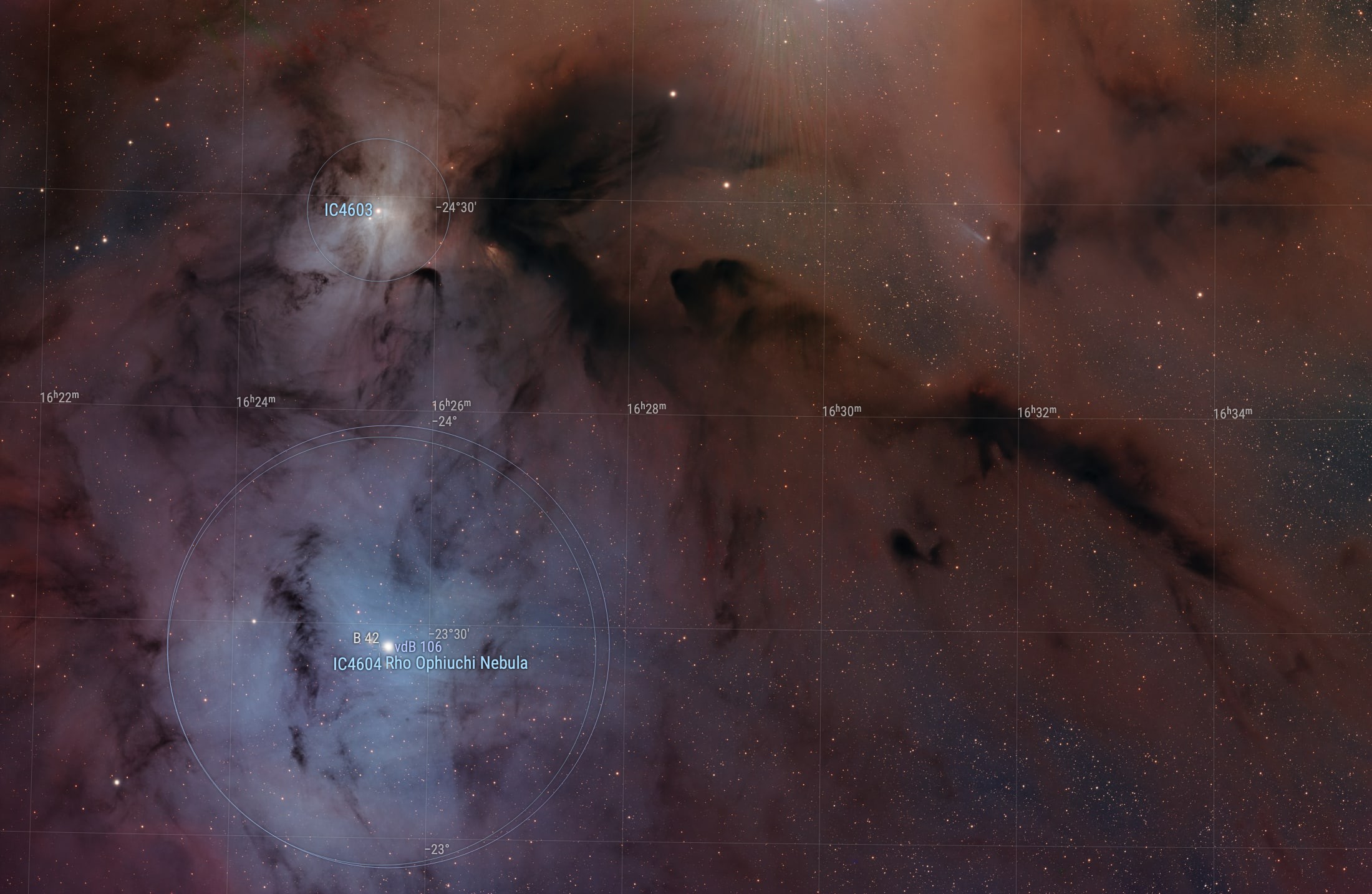
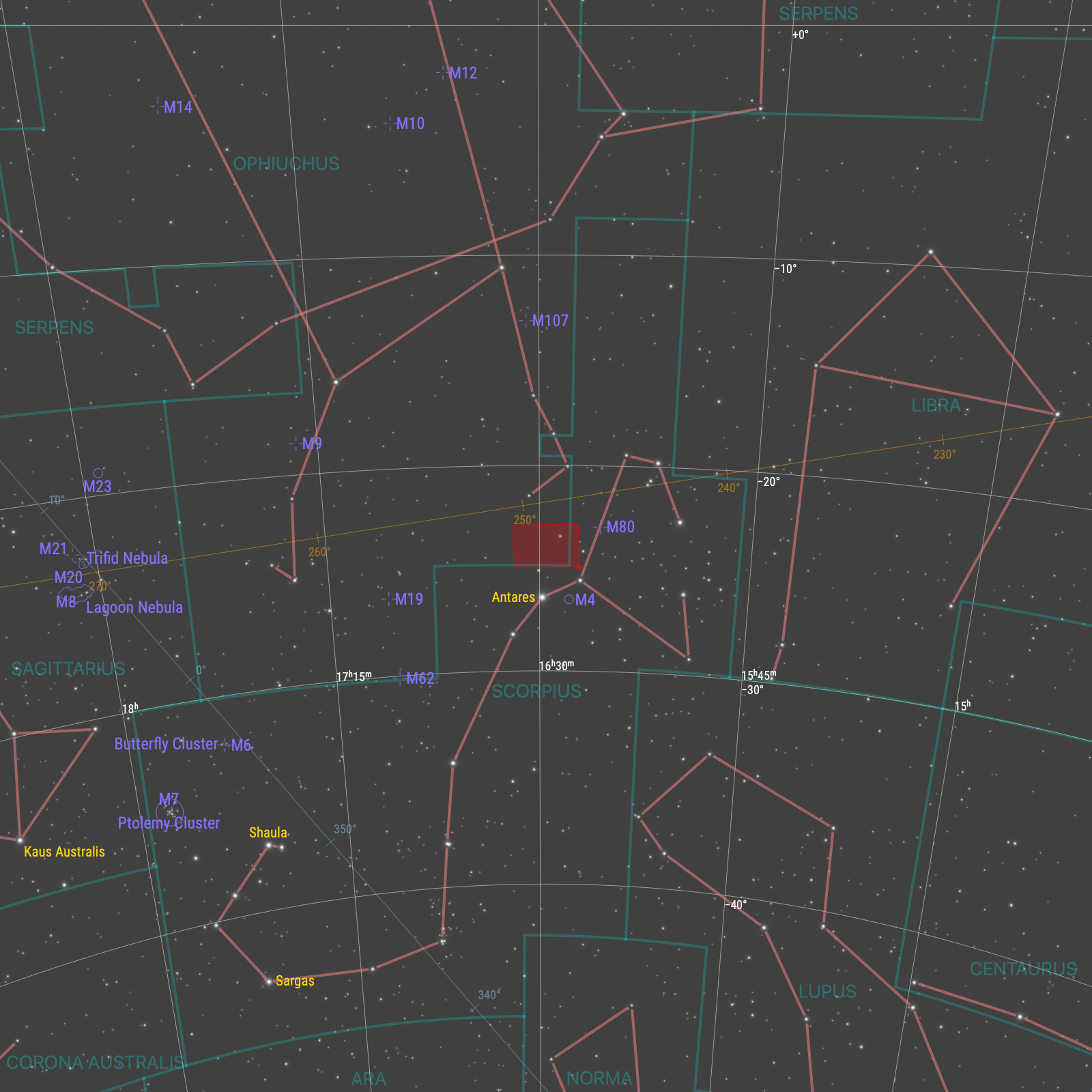
Annotation and chart generated in PixInsight (AnnotateImage, FindingChart) from the image's astrometric solution.
Acquisition
- Location
- Starfront remote site, Texas (31°32'51" N, 99°22'55" W)
- Period
- 26 March to 8 July 2026
- Camera
- QHY268M (monochrome), gain 56, offset 25, High Gain 2CMS mode, cooled to −15 °C then to 0 °C, 1×1 binning
- Optics
- SharpStar 94EDPH refractor (94 mm aperture) with its dedicated reducer, 409 mm focal length (f/4.4)
- Image scale
- 1.90"/pixel (3.76 µm pixels)
- Filters
- L, R, G, B
- Software
- Voyager (RoboTarget)
Frames kept (all available raw frames were stacked):
| Filter | Frames | Sub-exposure | Total | Period |
|---|---|---|---|---|
| L | 100 | 180 s | 5.0 h | 26 March to 27 March 2026 |
| R | 100 | 180 s | 5.0 h | 27 March to 22 June 2026 |
| G | 100 | 180 s | 5.0 h | 22 June to 4 July 2026 |
| B | 92 | 180 s | 4.6 h | 4 July to 8 July 2026 |
- Integration time
- 19.6 h (392 frames).
Final image
- Dimensions
- 6108 × 3978 pixels (24.3 megapixels), after cropping the edges
- Field
- about 3.2° × 2.1°
- Field centre
- RA 16h 29m, Dec −23° 56'
Processing
Done entirely in PixInsight 1.9.6, starting from the raw frames.
Preprocessing (per filter)
- Calibration: 180 s master darks at −15 °C and at 0 °C depending on the frame; L, R, G, B master flats at −15 °C from December 2025.
- Frame alignment, local normalization, stacking.
- Astrometric solution of each stack.
Preparation
- RGB combination and colour calibration on the stars in the field (SpectrophotometricColorCalibration, Gaia catalogue).
- Common cropping of the edges.
Linear processing
- Light gradient correction (AutomaticBackgroundExtractor, degree-1 polynomial).
- BlurXTerminator (deconvolution), NoiseXTerminator (noise reduction), StarXTerminator (separation of stars and nebulae).
Non-linear processing
- Background neutralization, then linked stretch of the three colours, target background level 0.20.
- Combination of the luminance with the colour (LRGB).
- Green toned down (SCNR 0.7), contrast and saturation curves.
- DarkStructureEnhance, two passes, to strengthen the dark nebulae.
- Reintegration of the stars, stretched less than the nebulae.
Notes
- At the latitude of the site, this field only rises to about 35° above the southern horizon.
- Some of the frames were taken at 0 °C and calibrated with flats at −15 °C, for lack of a closer flat in date.
Image: Martin Magnan.