Gallery · M16
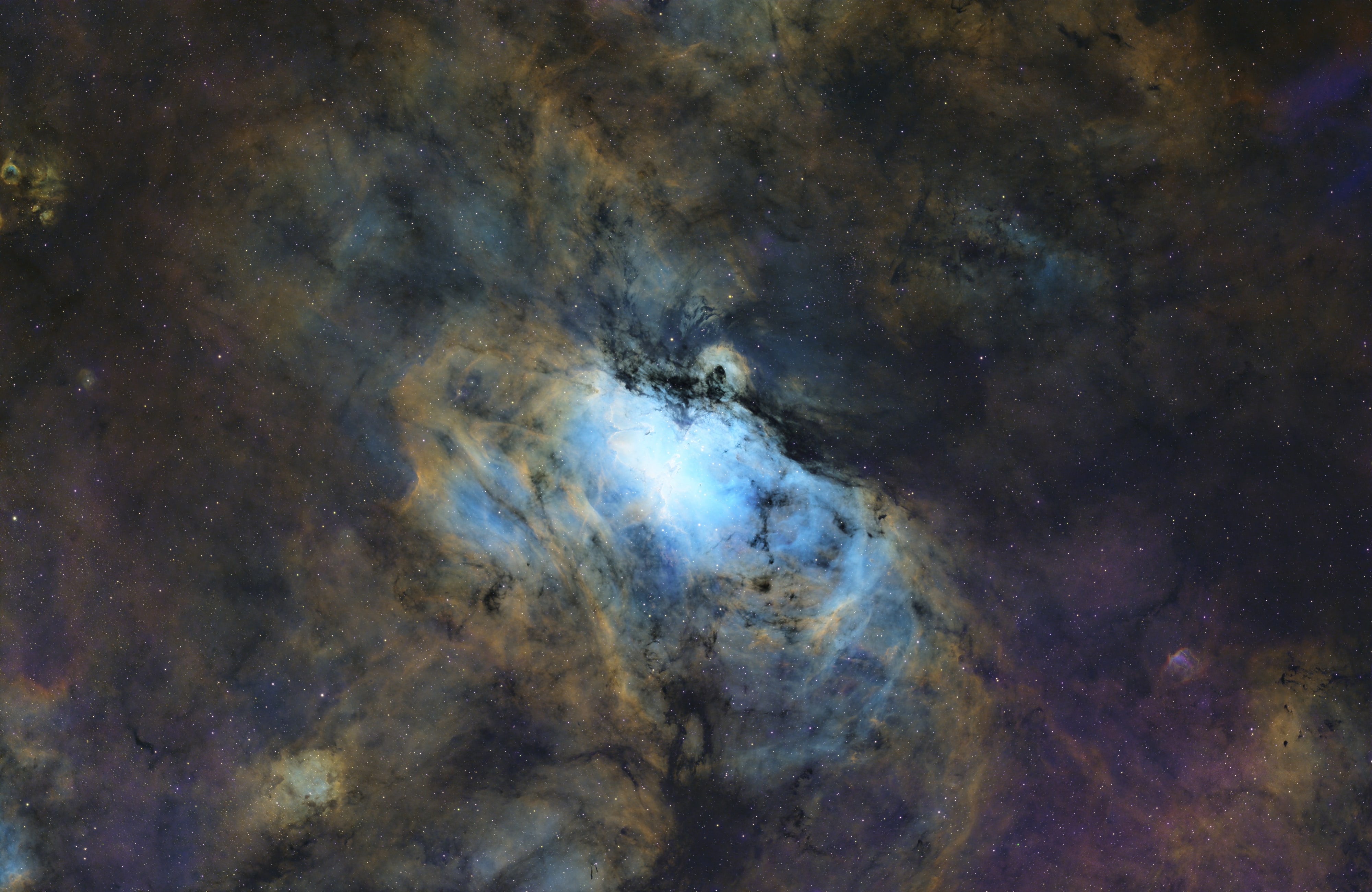
The Eagle Nebula
Single-image narrowband, SHO (Hubble) palette
- Integration
- 50.8 h
- Constellation
- Serpens
- Optics
- SharpStar 94EDPH refractor
- Camera
- QHY268M
- Field of view
- 3.2° × 2.1°
- Dates
- 9 September 2025 to 4 July 2026
Description
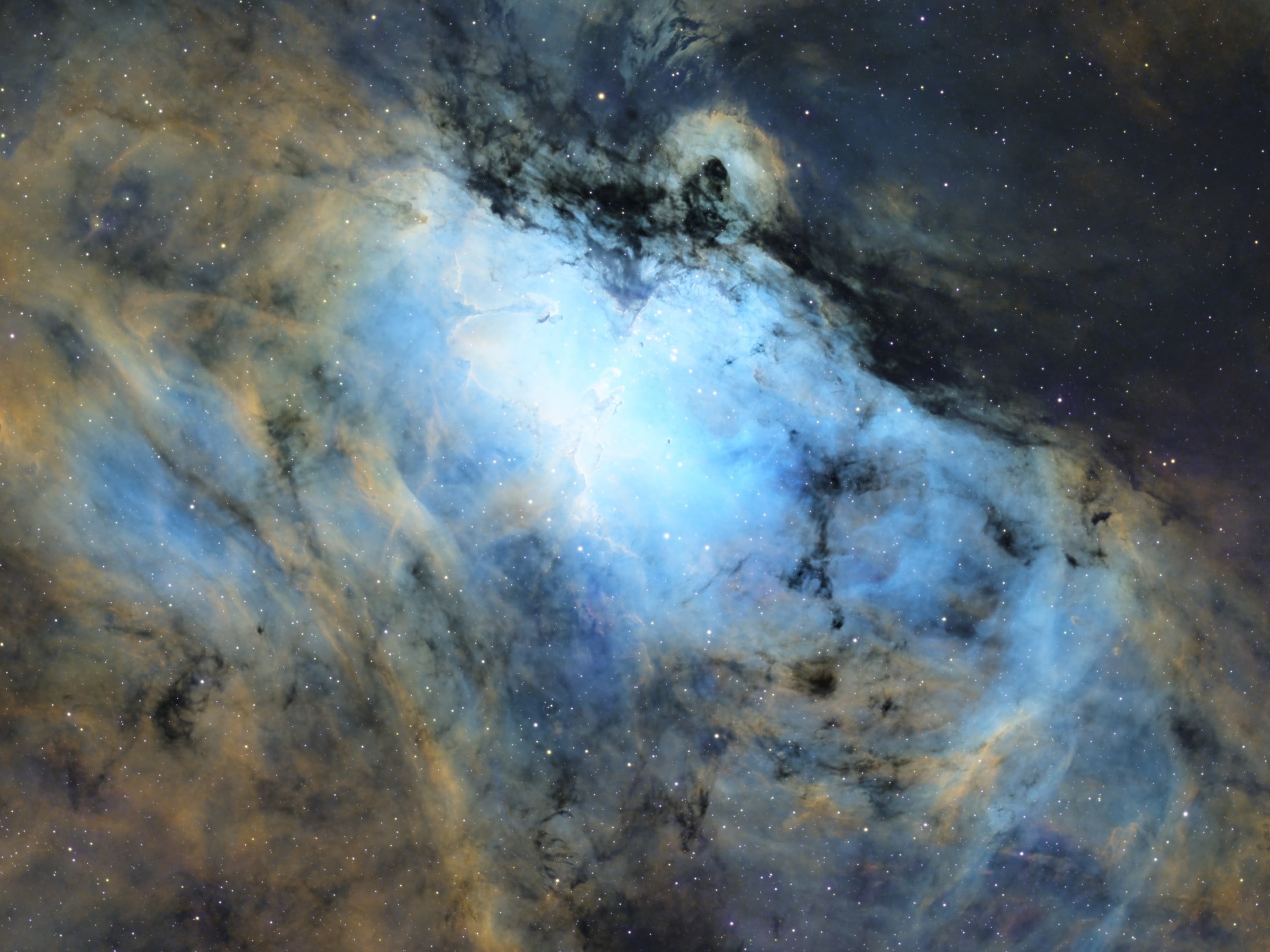
This 3.2° by 2.1° field, in the summer Milky Way, is centred on M16, the Eagle Nebula, about 5,700 light-years away. It is a vast star-forming region: the young cluster NGC 6611, born from this cloud, ionizes its gas and carves a cavity in it, visible here in blue at the centre.
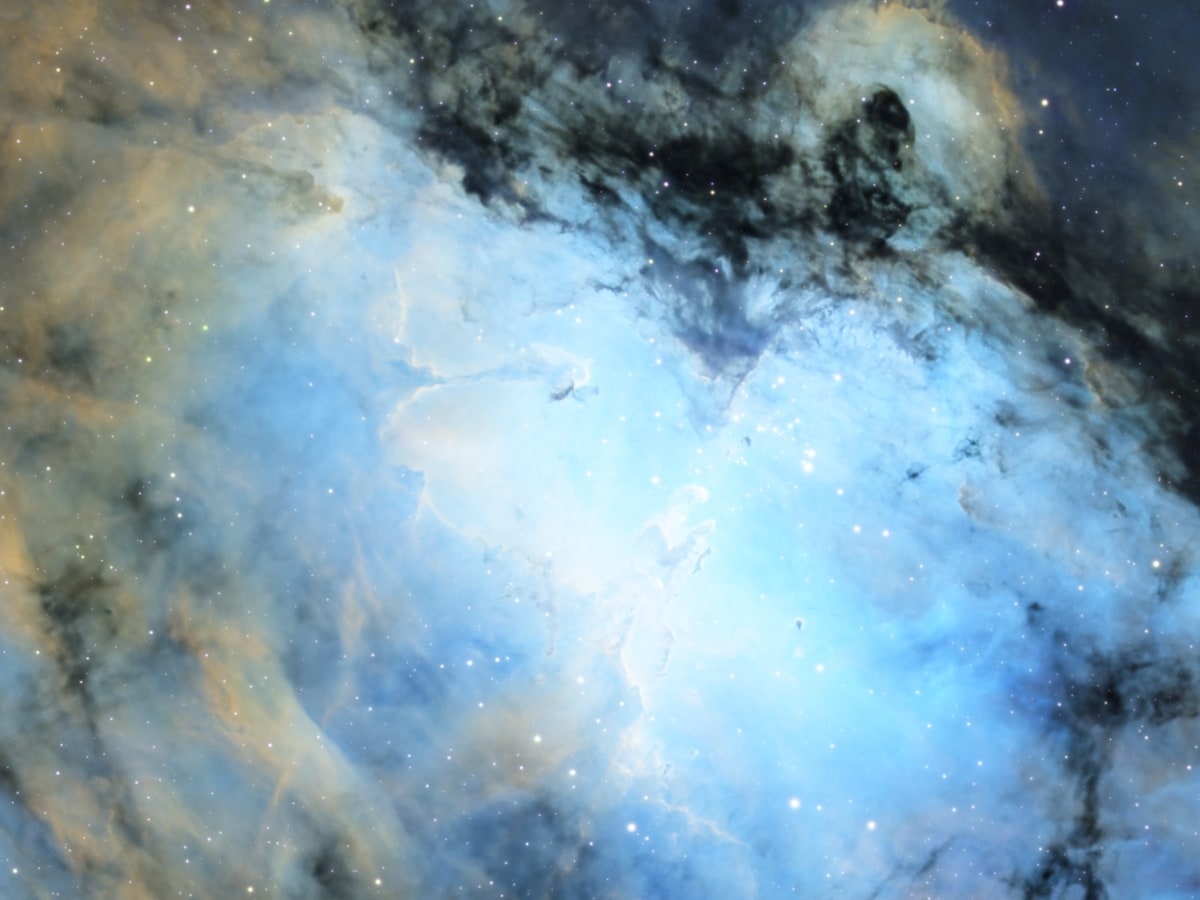
In this cavity stand long columns of gas and cold dust, sculpted by the radiation of the stars: the "Pillars of Creation", made famous by the Hubble Space Telescope. They appear as small dark silhouettes in the heart of the bright area.
All around, the field is filled with clouds of hydrogen and sulphur in golden tones and numerous dark nebulae.
This image was acquired in collaboration with Renaud Venne-Landry.
Finding the field
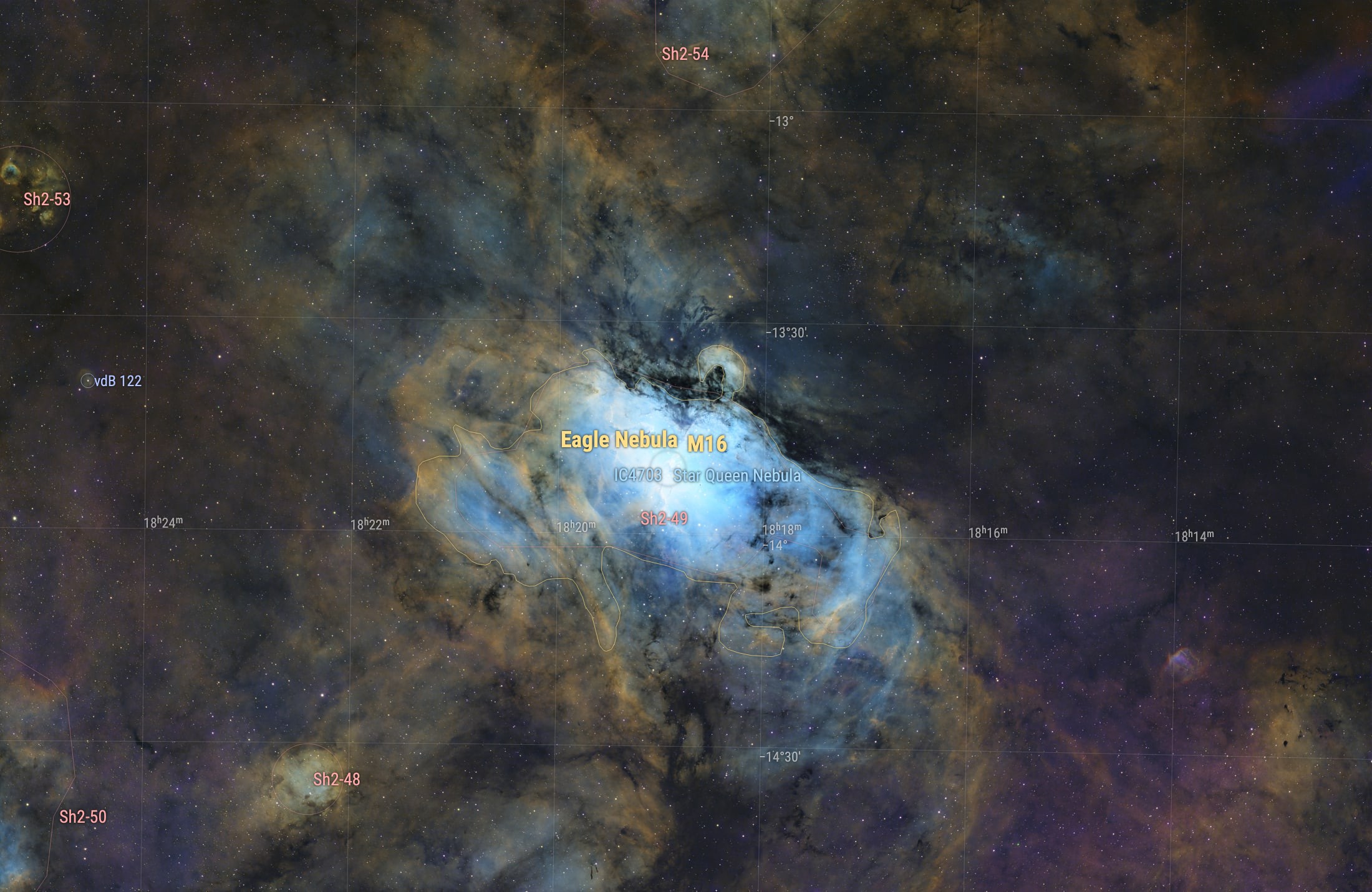
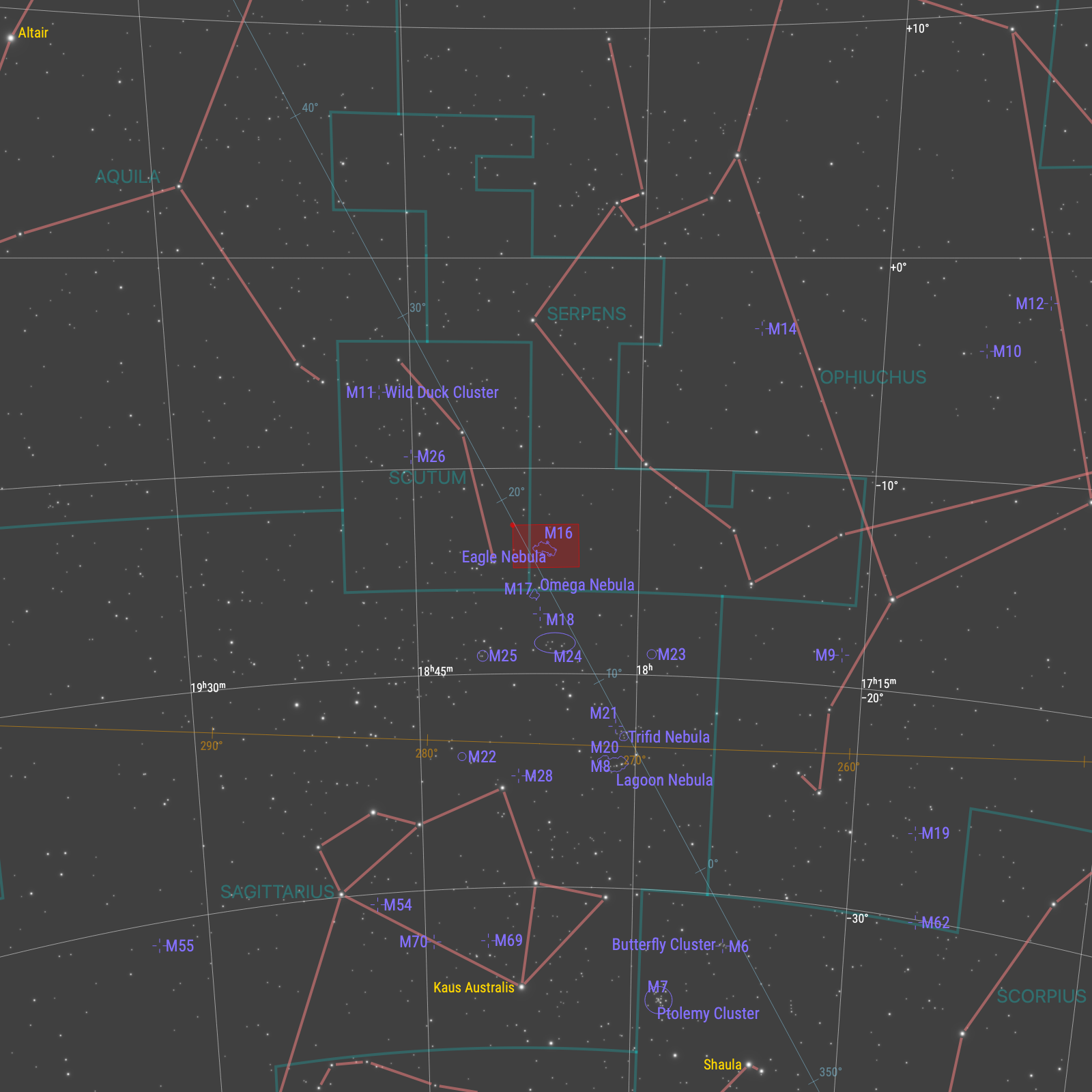
Annotation and chart generated in PixInsight (AnnotateImage, FindingChart) from the image's astrometric solution.
Acquisition
- Location
- Starfront remote site, Texas (31°32'51" N, 99°22'55" W)
- Period
- 9 September 2025 to 4 July 2026
- Camera
- QHY268M (monochrome), gain 56, offset 25, High Gain 2CMS mode, cooled to 0 °C (−15 °C for part of the OIII), 1×1 binning
- Optics
- SharpStar 94EDPH refractor (94 mm aperture) with its dedicated reducer, 409 mm focal length (f/4.4)
- Image scale
- 1.90"/pixel (3.76 µm pixels)
- Filters
- Ha, OIII, SII
- Software
- Voyager (RoboTarget)
Frames kept (all available raw frames were stacked):
| Filter | Frames | Sub-exposure | Total | Period |
|---|---|---|---|---|
| Ha | 105 | 600 s | 17.5 h | 9 September to 3 November 2025 |
| OIII | 100 | 600 s | 16.7 h | 29 March to 18 June 2026 |
| SII | 100 | 600 s | 16.7 h | 18 June to 4 July 2026 |
- Integration time
- 50.8 h (305 frames).
Final image
- Dimensions
- 6156 × 4002 pixels (24.6 megapixels), after cropping the edges
- Field
- about 3.2° × 2.1°
- Field centre
- RA 18h 19m, Dec −13° 49'
Processing
Done entirely in PixInsight 1.9.6, starting from the raw frames.
Preprocessing (per filter)
- Calibration: 600 s master dark at 0 °C and at −15 °C depending on the frame; Ha master flat from October 2025; OIII and SII master flats at −15 °C from December 2025.
- Frame alignment, local normalization, stacking.
- Astrometric solution of each stack.
Preparation
- SHO combination (R = SII, G = Ha, B = OIII) for the nebulae.
- Common cropping of the edges.
Linear processing
- BlurXTerminator (deconvolution), NoiseXTerminator (noise reduction), StarXTerminator (separation of stars and nebulae).
Non-linear processing
- Channel-by-channel stretch, target background level 0.20.
- Green toned down (SCNR 0.7), contrast and saturation curves.
- DarkStructureEnhance, two passes, to strengthen the dark nebulae.
- Reintegration of the stars, stretched less than the nebulae.
Notes
- No RGB frames were taken for this target: the colour of the stars comes from the narrowband filters and is not their real colour.
Image: Martin Magnan.